Genie lists battery backup on the 7155 and says it can provide up to 50 door cycles from the initial power failure under favorable conditions. Genie also says battery operation is slower and the opener light does not function on battery power, so those two changes can be normal during an outage rather than signs that the 7155 motor has failed.
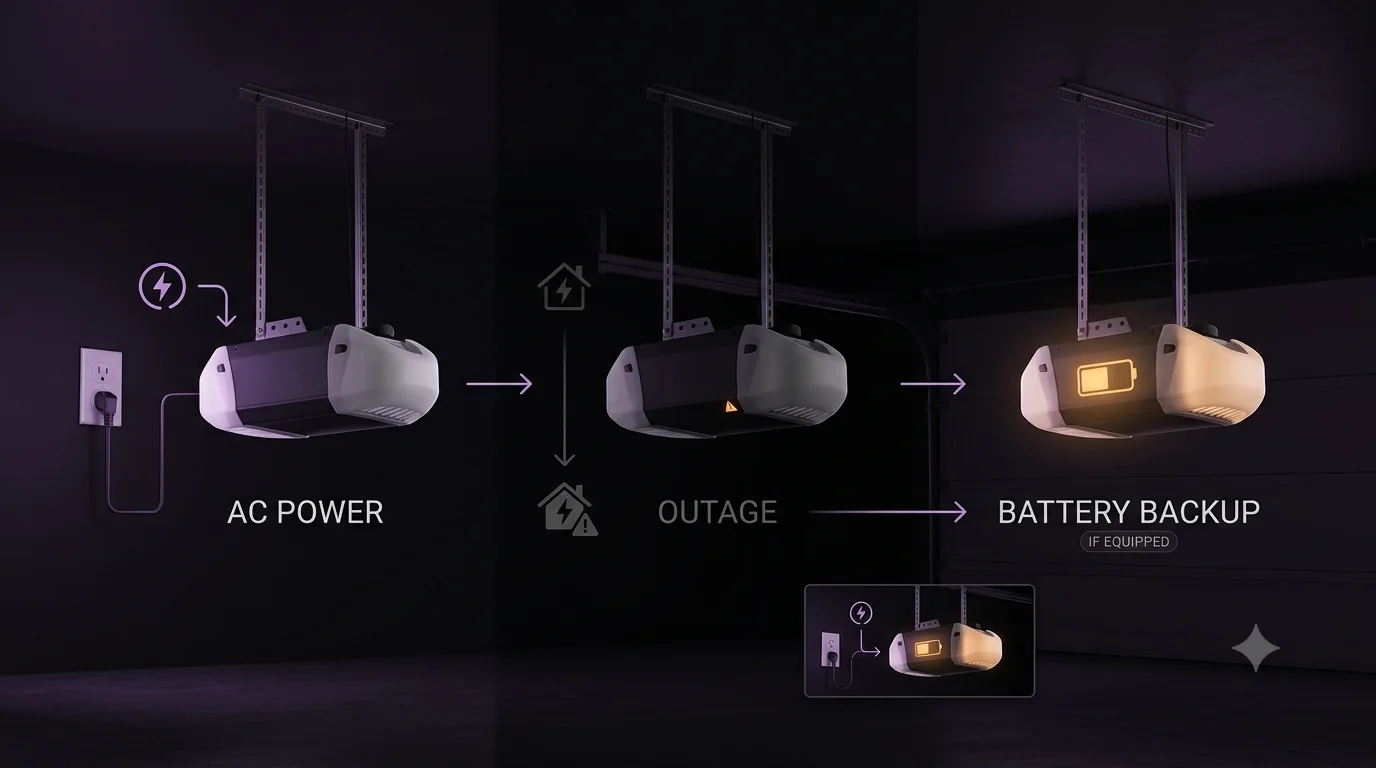
Diagnostic snapshot
- Answer
- The Genie 7155 includes battery backup. Genie states that it can provide up to 50 door cycles from the initial power failure under favorable conditions, but battery operation is intentionally reduced compared with normal AC operation.
- Check first
- First confirm the outage and whether the battery had time to charge; a weak/aged battery, heavy door, cold conditions, or long outage can reduce available cycles.
- Strong clue
- Genie's battery-backup guidance says opener lighting does not operate on battery power and operating speed is reduced to conserve energy.
- Model / generation note
- The 7155 model page specifically lists battery backup; do not apply this behavior to a Genie model that lacks an installed/compatible backup battery.
Separate Genie battery-backup operation from a normal AC-power state
Did the outage remove AC power while the opener moved onto its backup battery?
On the documented Genie 7155 battery-backup path, outage behavior should be read as a power-source state first. Confirm normal AC returns and use the model-specific battery guidance before treating backup operation as a general motor fault.
What you are likely to notice
- The Genie 7155 is operating during a house power outage
- The door moves more slowly than usual
- The opener light does not come on while running on battery
- The battery provides fewer cycles than expected
Check these in order
1. Confirm that the 7155 is actually on backup power
The 7155 includes battery backup, so continued door operation during a utility outage is expected. Separate outage behavior from a normal-AC closing problem before changing limits, sensors, or remote programming.
2. Expect reduced speed and no opener light on battery
Genie's battery-backup support says operating speed is reduced to conserve power and the opener's light does not function while on battery. Those behaviors alone do not identify a failed motor or LED system.
3. Treat 50 cycles as an upper-condition figure, not a promise
Genie says the 7155 feature provides up to 50 cycles from the initial power failure, and its battery support notes that door weight, battery age, temperature, elapsed outage time, and battery condition affect real-world cycle count.
4. Give the battery time to charge after power returns
Genie battery-backup support says the batteries can take about 48 hours to fully charge. If runtime was low after a long outage, restore AC power and allow charging before deciding the battery is defective.
What 'up to 50 cycles' actually means
Genie markets the 7155 battery backup as providing up to 50 cycles from the initial power failure. Its battery-support documentation adds the conditions behind that number: battery age, door weight, environmental temperature, how long the outage has lasted, and how fully the battery was charged all affect the real total.
That is why a homeowner should not diagnose a failed battery from one outage by counting against 50 as though it were a guaranteed minimum. A heavy door or cold garage can reduce runtime, and an older battery that was not fully charged starts with less available energy.
Slower movement and no opener light can be normal on battery
Genie says the opener's light does not function under battery power and that opener speed is reduced to conserve energy. Those are two especially useful model-behavior clues because they can look like two simultaneous failures when the real cause is simply backup-power mode.
After AC power returns, allow the battery time to recharge. Genie support says batteries may take about 48 hours to reach full charge. If the 7155 continues to show poor battery performance after normal charging and the door moves freely, use the exact battery/status instructions rather than changing travel or Safe-T-Beam alignment without a matching symptom.
Stop DIY troubleshooting when…
- The battery is swollen, leaking, hot, or physically damaged
- The door is heavy, binds, or has damaged springs/cables
- The opener shows a different diagnostic fault unrelated to the outage
- Battery performance remains abnormal after verified charging and normal door movement
Garage door springs, cables and a falling/unbalanced door can store or release dangerous force. Those are door-system problems, not just opener settings.
Common questions
How many times can a Genie 7155 open during a power outage?
Genie says the 7155 battery-backup feature can provide up to 50 cycles from the initial power failure under favorable conditions. Actual cycles vary with battery age, door load, temperature, charge, and outage duration.
Why is the Genie 7155 slower during a power outage?
Genie says operating speed is reduced on battery power to conserve energy.
Why does the Genie 7155 light stay off while battery backup is running?
Genie's battery-backup support says the opener light does not function under battery power, so this can be normal during an outage.
Manufacturer sources used
These links are the factual baseline for the diagnostic claims above. Model-specific manuals can supersede general guidance.